
The case for breakfast
Updated: Nov 19, 2025
Is breakfast really that important? The research is mixed. But it may be worth a try to add to your morning routine. ✨

I was born and raised with a breakfast routine: I've been eating cereal with milk in the mornings for as long as I can remember. I have my parents to thank for instilling a love for cereal early (see photos) and teaching me to read the nutrition facts labels and choose whole-grain cereals with fiber. My mom's rule when I was young was that any cereal she bought for us had to have at least 2 grams of fiber per serving. A good rule of thumb for sure, and luckily, plenty of delicious choices in the cereal aisle met that mark.


These days, I mix up my breakfast choices here and there, but cereal is still strong in the rotation. Whole-grain cereal (that is low in sugar and has fiber and protein) with some kind of milk (unsweetened almond milk is my choice now) is a great and easy way to get a balanced meal in the mornings and keeps my breakfast routine going.
My routine is only sustainable, though, because fortunately my body accepts breakfast; breakfast makes my body feel good. I know that everyone is different, and not everyone can stomach a meal in the morning. During my dietetics training I met many clients who lamented that they wished they could eat breakfast - "it's the most important meal of the day" - but it made them nauseous, or they didn't have time, or their appetite was nonexistent, or they weren't sure what to eat.
For many, eating breakfast regularly is just not as easy as eating a bowl of cereal minutes after waking up. And that's okay! If you're not used to eating in the mornings, it may take some trial and error to determine the eating pattern that makes you feel best. In this article I'll explore what the research says about breakfast's importance and discuss some ideas for building a balanced breakfast routine that fits your life.
What the current scientific research says about breakfast
Based on my reading, the research is mixed on whether breakfast-eating is definitely more healthy than breakfast-skipping. Having a sustainable routine that ensures adequate and balanced nutrition seems to be the most important thing.
Some studies have shown benefits to eating in the mornings. Breakfast-eaters have been shown in some studies to have better concentration and cognitive function, consume higher amounts of necessary nutrients, and have better blood sugar control than breakfast-skippers.1 Breakfast-skipping has been associated with higher rates of depression and anxiety, so eating breakfast may be protective for mental health.2 Some studies showed that breakfast-eating reduced the risk of unhealthy weight gain down the line, and breakfast-skipping was associated with an increased risk of mortality from cancer and cardiovascular disease.3-5 In general, eating regular meals at regular times (not just in the morning) has been shown to help your body calibrate its internal clock.6-8 The biological clock is involved in many body processes, directing hormone releases and adjusting metabolism.6-8 When it comes to eating, your biological clock can prompt hunger (and subsequent eating), but it works the other way, too: meals prompt metabolic processes.7 Eating regularly avoids large swings in blood sugar, perhaps stabilizing moods, energy levels, and hunger/fullness cues.7 Keeping mealtimes regular may also help maintain a healthy weight by reducing later cravings of highly-caloric foods4 (though another study found that weight changes were similar among breakfast-skippers and breakfast-eaters7).
So, having some kind of routine of eating in the morning might be helpful, and I encourage giving it a try. Eating a higher percentage of your calories earlier in the day and having breakfast after an overnight fast might help with calibrating your internal clock and regulating hormones.6-7,9 But it seems the most important thing is to have a consistent eating pattern that works for you.9 So whether that looks like 2 meals a day at 10 AM and 4 PM or 3 meals a day at 6 AM, 12 PM, and 7 PM, having a consistent routine that meets your needs can contribute to overall metabolic health.

5 things to consider when starting or checking in with your breakfast routine
If you're interested in experimenting with a breakfast routine - or even if you already have one - consider these ideas to make your breakfast balanced and personalized.
Think of breakfast as an opportunity to get some nutrients in. Eating breakfast regularly has been shown to increase intake of vital micronutrients.3 Makes sense - another eating occasion will give you a chance to eat more nutrients. The key is to make sure your breakfast is nutrient-dense. See #2 below!
Choose a variety of food groups. In general, a "balanced" meal can be defined as one that includes a variety of food groups for a mix of different nutrients. I find the MyPlate model to be the easiest visual tool to keep in mind when meal planning.10 The "plate" visual doesn't work for every meal, because you might be eating a sandwich, or just a snack, or a smoothie - but for these non-plate-shaped meals, think of it in terms of fractions of the total meal or snack you're eating. Aim for half of your meal to be fruits and vegetables, a quarter to be from lean proteins (lean meats, beans, nuts and seeds, even cottage cheese or yogurt), and a quarter to be from whole grains (whole grain bread, brown rice, whole grain cereal, etc.).
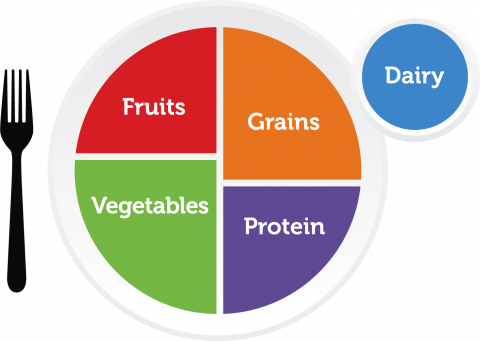
MyPlate, a visual guide for meal planning, replaced the food pyramid in 2011. It doesn't have to be a whole meal. Having a low appetite or limited time in the morning can make it tempting to skip breakfast altogether. But breakfast doesn't have to be a whole production. Maybe just having a small bowl of whole-grain cereal with milk, one pack of trail mix, one hard-boiled egg, some apple slices with peanut butter, or another snack-sized meal is doable and will set your body up for meeting your nutrient goals during the day!
Have an away-from-home game plan. If eating at home before you start your day just isn't in the cards, or you'll be traveling or on the road early, consider either planning a balanced snack that you can bring for breakfast OR thinking in advance about a go-to convenience food that you can buy while you're out. Some of my on-the-go breakfast go-tos are:
Sandwich bag of whole-grain cereal (Quaker Oatmeal Squares these days) and a protein shake
Egg McMuffin (just the sandwich) from McDonald's +/- a piece of fruit
Oatmeal from Starbucks
Kind Bar +/- fruit or yogurt
6-inch turkey sub from Subway
"Breakfast" is what you make it. Feel uninspired by traditional American breakfast foods (cereal, toast, pancakes, eggs, etc.)? I have to admit that aside from cereal, I'm not a huge fan myself. Consider thinking outside the box for what to eat in the mornings. I have a friend who eats a meat-and-vegetable stir-fry every morning. Sometimes I crave a salad or a sandwich in the mornings (and Panera Bread WILL serve you a Greek salad at 8 AM, I've learned 😆 ). Really, anything that gets your body fed works, and it might end up being more balanced - and more delicious?? - than the traditional American breakfast. ✨

Thanks for reading! Have questions or comments? Email me here!
References
Harris JA, Carins JE, Rundle-Thiele S. A systematic review of interventions to increase breakfast consumption: a socio-cognitive perspective. Public Health Nutr. 2021;24(11):3253-3268. doi:10.1017/S1368980021000070
Breakfast consumption and mental health: a systematic review and meta-analysis of observational studies: Nutritional Neuroscience: Vol 25, No 6. Accessed October 15, 2025. https://www.tandfonline.com/doi/10.1080/1028415X.2020.1853411?url_ver=Z39.88-2003&rfr_id=ori:rid:crossref.org&rfr_dat=cr_pub%20%200pubmed
Wicherski J, Schlesinger S, Fischer F. Association between Breakfast Skipping and Body Weight—A Systematic Review and Meta-Analysis of Observational Longitudinal Studies. Nutrients. 2021;13(1):272. doi:10.3390/nu13010272
Bonnet JP, Cardel MI, Cellini J, Hu FB, Guasch-Ferré M. Breakfast Skipping, Body Composition, and Cardiometabolic Risk: A Systematic Review and Meta-Analysis of Randomized Trials [Abstract only]. Obesity (Silver Spring). 2020;28(6):1098-1109. doi:10.1002/oby.22791
Wang Y, Li F, Li X, et al. Breakfast skipping and risk of all-cause, cardiovascular and cancer mortality among adults: a systematic review and meta-analysis of prospective cohort studies [Abstract only]. Food Funct. 2024;15(11):5703-5713. doi:10.1039/d3fo05705d
Takahashi M, Tahara Y. Timing of Food/Nutrient Intake and Its Health Benefits: Chrono-Nutrition (SY(T1)4). J Nutr Sci Vitaminol. 2022;68(Supplement):S2-S4. doi:10.3177/jnsv.68.S2
Smith HA, Betts JA. Nutrient timing and metabolic regulation. J Physiol. 2022;600(6):1299-1312. doi:10.1113/JP280756
Katsi V, Papakonstantinou IP, Soulaidopoulos S, Katsiki N, Tsioufis K. Chrononutrition in Cardiometabolic Health. J Clin Med. 2022;11(2):296. doi:10.3390/jcm11020296
Chrononutrition and Cardiometabolic Health: An Overview of Epidemiological Evidence and Key Future Research Directions - PMC. Accessed October 15, 2025. https://pmc.ncbi.nlm.nih.gov/articles/PMC11280377/
MyPlate.gov | What Is MyPlate? Accessed October 21, 2025. https://www.myplate.gov/eat-healthy/what-is-myplate
